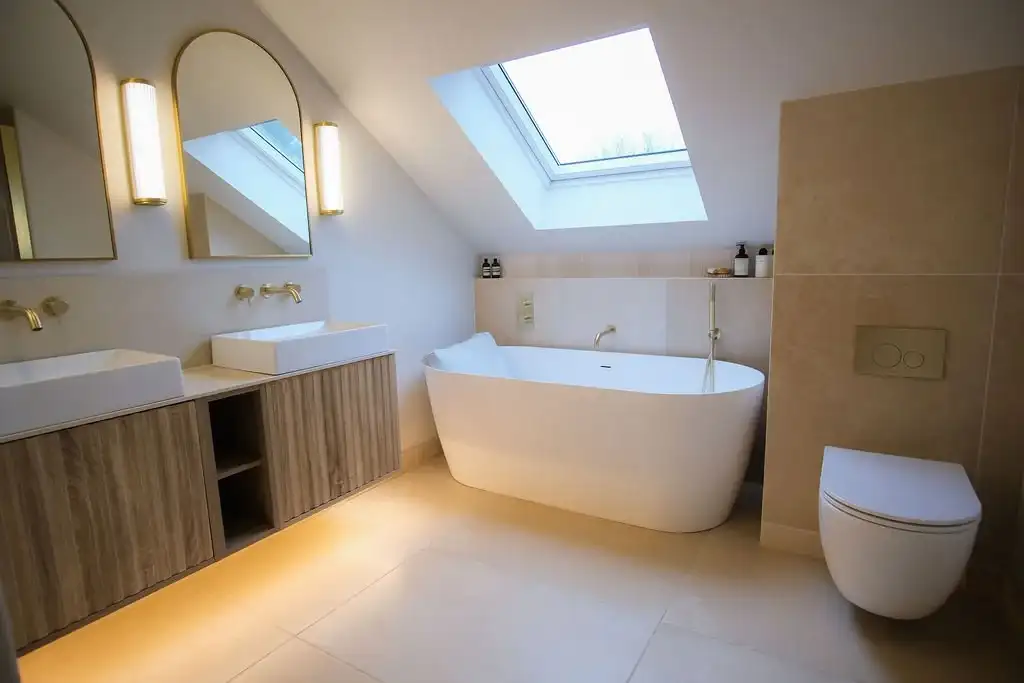
Bathroom renovation Woking projects look different depending on where in the borough your house sits. Old Woking's riverside cottages, Horsell's Edwardian villas and 1930s semis, and the 1960s and 70s estates of Goldsworth Park and Sheerwater each raise their own planning and plumbing questions. It's worth working through them before a design is finalised.
Bathroom Renovation Woking: Listed Buildings in Old Woking and Horsell
A standard bathroom refit is internal work, so it normally sits outside planning control wherever you live in Woking. Building Regulations sign-off is still needed for the plumbing, electrics and ventilation. This is usually arranged through a registered installer under a competent person scheme, not a full council application. The exception is a listed building. Old Woking, the borough's oldest conservation area, and Horsell's conservation area both contain listed cottages and villas. Inside one of these, removing a wall, altering old joinery, or lifting floorboards for new pipework can need listed building consent from Woking Borough Council, the local planning authority for the whole borough, even though the same work needs no permission in a later, unlisted house streets away.
Flood Risk Near the River Wey and Hoe Stream
Old Woking sits close to the River Wey, and the Hoe Stream, one of its tributaries, has its own Environment Agency flood warning area covering parts of the town. During heavy rain, low-lying land near Old Woking's historic core can flood. That matters for any ground-floor bathroom or wet room nearby. Check the Environment Agency's flood map for your postcode before the design is finalised. Build in water-resistant flooring and raised sockets if the risk turns out to be real.
Matching the Work to Your Property
Victorian and Edwardian terraces around the town centre and Maybury often still run on older single-stack plumbing, sometimes in lead or galvanised steel, worth replacing rather than tiling over once it's exposed. Horsell's 1930s semis and St John's interwar housing tend to have a more generously sized family bathroom, though the pipework behind the walls is frequently just as old. The postwar estates at Goldsworth Park and Sheerwater, built mostly in the 1960s and 70s, are the simplest case: modern copper or plastic plumbing throughout usually means a straightforward refit with far fewer surprises once the old suite comes out. Woking's water is also hard, like most of this part of Surrey, so fitting a scale inhibitor while the system is already open is a small addition that protects new fittings from day one.
Frequently Asked Questions
Does a listed cottage in Old Woking need consent for new bathroom plumbing?
Often, yes, if the work touches original fabric. Old Woking's conservation area contains listed cottages near the Wey, and removing a wall, altering old joinery, or exposing floor joists to run new pipework as part of a bathroom renovation can need listed building consent from Woking Borough Council, even for changes made entirely inside the house.
Can Hoe Stream flooding affect a ground-floor bathroom in Old Woking?
It can, during heavy rainfall. The Hoe Stream has its own Environment Agency flood warning area covering parts of Woking, and low-lying land near Old Woking's historic core can flood as a result. A ground-floor bathroom here should use water-resistant flooring and raised sockets, and it's worth checking the flood map for your postcode first.
Are bathrooms easier to renovate in Goldsworth Park or Sheerwater than in Horsell?
Generally, yes, from a plumbing point of view. Goldsworth Park and Sheerwater's 1960s and 70s estate housing usually has straightforward modern copper or plastic pipework, while Horsell's older Edwardian villas and 1930s semis, some inside a conservation area, more often need the pipework checked and sometimes replaced alongside the new suite.
If you're planning a bathroom renovation in Woking, take a look at our bathrooms page for examples of recent work, or get in touch to talk through what your home would need. Our guide to home extensions in Woking covers the same conservation areas and flood risk in more detail.